
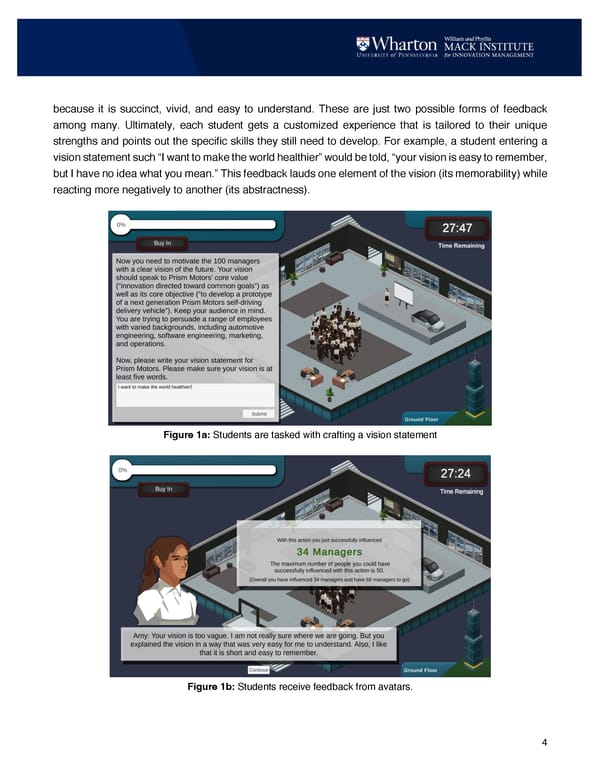
4 because it is succinct, vivid, and easy to understand. These are just two possible forms of feedback among many. Ultimately, each student gets a customized experience that is tailored to their unique strengths and points out the specific skills they still need to develop. For example, a student entering a vision statement such “I want to make the world healthier” would be told, “your vision is easy to remember, but I have no idea what you mean.” This feedback lauds one element of the vision (its memorability) while reacting more negatively to another (its abstractness). Figure 1a: Students are tasked with crafting a vision statement Figure 1b: Students receive feedback from avatars.
 Beyond Multiple Choice: The Role of Large Language Models in Educational Simulations Page 3 Page 5