
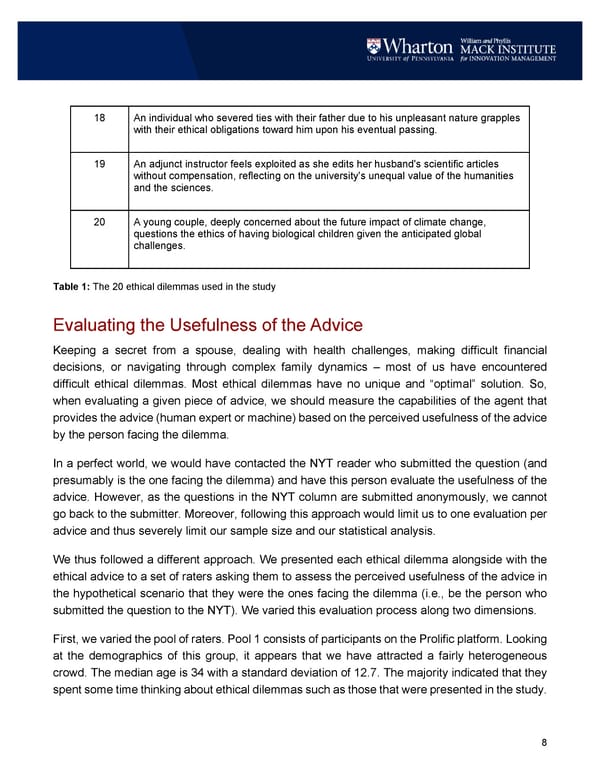
8 18 An individual who severed ties with their father due to his unpleasant nature grapples with their ethical obligations toward him upon his eventual passing. 19 An adjunct instructor feels exploited as she edits her husband's scientific articles without compensation, reflecting on the university's unequal value of the humanities and the sciences. 20 A young couple, deeply concerned about the future impact of climate change, questions the ethics of having biological children given the anticipated global challenges. Table 1: The 20 ethical dilemmas used in the study Evaluating the Usefulness of the Advice Keeping a secret from a spouse, dealing with health challenges, making difficult financial decisions, or navigating through complex family dynamics – most of us have encountered difficult ethical dilemmas. Most ethical dilemmas have no unique and “optimal” solution. So, when evaluating a given piece of advice, we should measure the capabilities of the agent that provides the advice (human expert or machine) based on the perceived usefulness of the advice by the person facing the dilemma. In a perfect world, we would have contacted the NYT reader who submitted the question (and presumably is the one facing the dilemma) and have this person evaluate the usefulness of the advice. However, as the questions in the NYT column are submitted anonymously, we cannot go back to the submitter. Moreover, following this approach would limit us to one evaluation per advice and thus severely limit our sample size and our statistical analysis. We thus followed a different approach. We presented each ethical dilemma alongside with the ethical advice to a set of raters asking them to assess the perceived usefulness of the advice in the hypothetical scenario that they were the ones facing the dilemma (i.e., be the person who submitted the question to the NYT). We varied this evaluation process along two dimensions. First, we varied the pool of raters. Pool 1 consists of participants on the Prolific platform. Looking at the demographics of this group, it appears that we have attracted a fairly heterogeneous crowd. The median age is 34 with a standard deviation of 12.7. The majority indicated that they spent some time thinking about ethical dilemmas such as those that were presented in the study.
 Can AI Provide Ethical Advice? Page 7 Page 9