
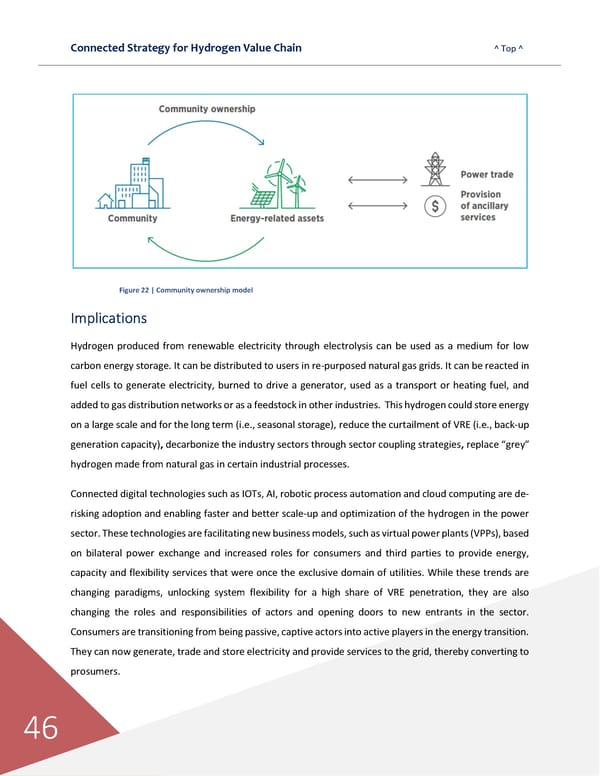
Connected Strategy for Hydrogen Value Chain ^ Top ^ 46 Figure 22 | Community ownership model Implications Hydrogen produced from renewable electricity through electrolysis can be used as a medium for low carbon energy storage. It can be distributed to users in re-purposed natural gas grids. It can be reacted in fuel cells to generate electricity, burned to drive a generator, used as a transport or heating fuel, and added to gas distribution networks or as a feedstock in other industries. This hydrogen could store energy on a large scale and for the long term (i.e., seasonal storage), reduce the curtailment of VRE (i.e., back-up generation capacity), decarbonize the industry sectors through sector coupling strategies, replace “grey” hydrogen made from natural gas in certain industrial processes. Connected digital technologies such as IOTs, AI, robotic process automation and cloud computing are de- risking adoption and enabling faster and better scale-up and optimization of the hydrogen in the power sector. These technologies are facilitating new business models, such as virtual power plants (VPPs), based on bilateral power exchange and increased roles for consumers and third parties to provide energy, capacity and flexibility services that were once the exclusive domain of utilities. While these trends are changing paradigms, unlocking system flexibility for a high share of VRE penetration, they are also changing the roles and responsibilities of actors and opening doors to new entrants in the sector. Consumers are transitioning from being passive, captive actors into active players in the energy transition. They can now generate, trade and store electricity and provide services to the grid, thereby converting to prosumers.
 Connected Strategies for the Hydrogen Value Chain Page 46 Page 48