
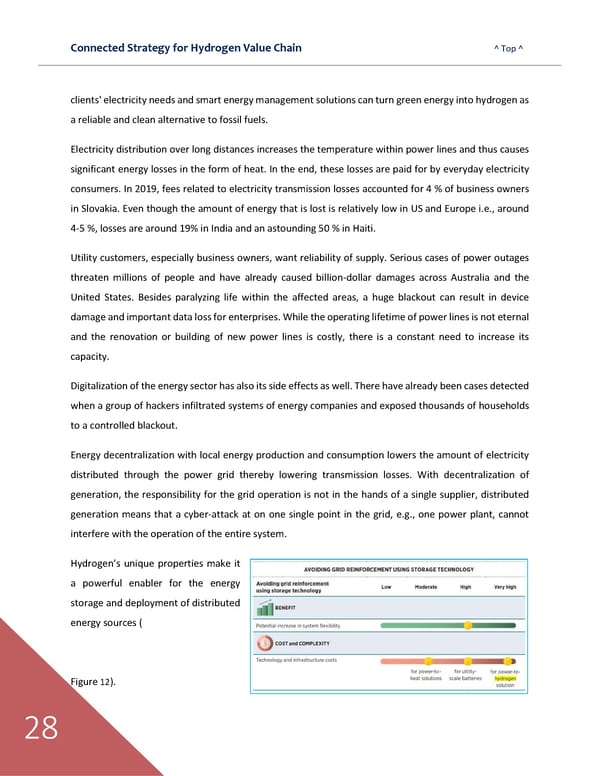
Connected Strategy for Hydrogen Value Chain ^ Top ^ 28 clients' electricity needs and smart energy management solutions can turn green energy into hydrogen as a reliable and clean alternative to fossil fuels. Electricity distribution over long distances increases the temperature within power lines and thus causes significant energy losses in the form of heat. In the end, these losses are paid for by everyday electricity consumers. In 2019, fees related to electricity transmission losses accounted for 4 % of business owners in Slovakia. Even though the amount of energy that is lost is relatively low in US and Europe i.e., around 4-5 %, losses are around 19% in India and an astounding 50 % in Haiti. Utility customers, especially business owners, want reliability of supply. Serious cases of power outages threaten millions of people and have already caused billion-dollar damages across Australia and the United States. Besides paralyzing life within the affected areas, a huge blackout can result in device damage and important data loss for enterprises. While the operating lifetime of power lines is not eternal and the renovation or building of new power lines is costly, there is a constant need to increase its capacity. Digitalization of the energy sector has also its side effects as well. There have already been cases detected when a group of hackers infiltrated systems of energy companies and exposed thousands of households to a controlled blackout. Energy decentralization with local energy production and consumption lowers the amount of electricity distributed through the power grid thereby lowering transmission losses. With decentralization of generation, the responsibility for the grid operation is not in the hands of a single supplier, distributed generation means that a cyber-attack at on one single point in the grid, e.g., one power plant, cannot interfere with the operation of the entire system. Hydrogen’s unique properties make it a powerful enabler for the energy storage and deployment of distributed energy sources ( Figure 12).
 Connected Strategies for the Hydrogen Value Chain Page 28 Page 30