
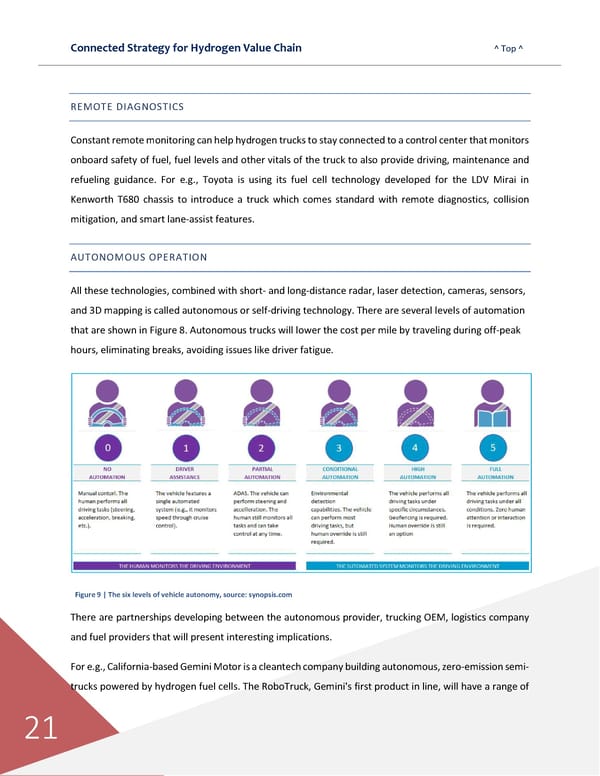
Connected Strategy for Hydrogen Value Chain ^ Top ^ 21 REMOTE DIAGNOSTICS Constant remote monitoring can help hydrogen trucks to stay connected to a control center that monitors onboard safety of fuel, fuel levels and other vitals of the truck to also provide driving, maintenance and refueling guidance. For e.g., Toyota is using its fuel cell technology developed for the LDV Mirai in Kenworth T680 chassis to introduce a truck which comes standard with remote diagnostics, collision mitigation, and smart lane-assist features. AUTONOMOUS OPERATION All these technologies, combined with short- and long-distance radar, laser detection, cameras, sensors, and 3D mapping is called autonomous or self-driving technology. There are several levels of automation that are shown in Figure 8. Autonomous trucks will lower the cost per mile by traveling during off-peak hours, eliminating breaks, avoiding issues like driver fatigue. Figure 9 | The six levels of vehicle autonomy, source: synopsis.com There are partnerships developing between the autonomous provider, trucking OEM, logistics company and fuel providers that will present interesting implications. For e.g., California-based Gemini Motor is a cleantech company building autonomous, zero-emission semi- trucks powered by hydrogen fuel cells. The RoboTruck, Gemini's first product in line, will have a range of
 Connected Strategies for the Hydrogen Value Chain Page 21 Page 23