
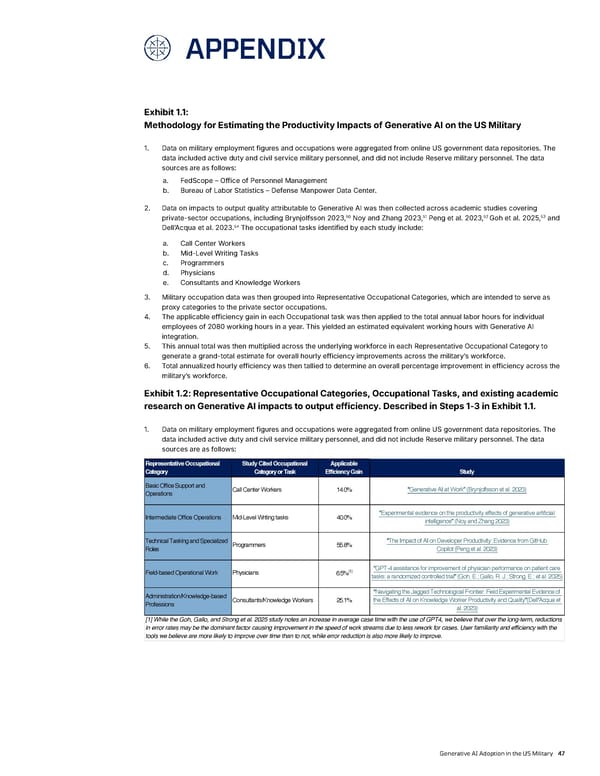
47 APPENDIX Exhibit 1.1: Methodology for Estimating the Productivity Impacts of Generative AI on the US Military 1. Data on military employment figures and occupations were aggregated from online US government data repositories. The data included active duty and civil service military personnel, and did not include Reserve military personnel. The data sources are as follows: Exhibit 1.2: Representative Occupational Categories, Occupational Tasks, and existing academic research on Generative AI impacts to output efficiency. Described in Steps 1-3 in Exhibit 1.1. 1. Data on military employment figures and occupations were aggregated from online US government data repositories. The data included active duty and civil service military personnel, and did not include Reserve military personnel. The data sources are as follows: 2. Data on impacts to output quality attributable to Generative AI was then collected across academic studies covering private-sector occupations, including Brynjolfsson 2023,50 Noy and Zhang 2023,51 Peng et al. 2023,52 Goh et al. 2025,53 and Dell’Acqua et al. 2023.54 The occupational tasks identified by each study include: 3. Military occupation data was then grouped into Representative Occupational Categories, which are intended to serve as proxy categories to the private sector occupations. 4. The applicable efficiency gain in each Occupational task was then applied to the total annual labor hours for individual employees of 2080 working hours in a year. This yielded an estimated equivalent working hours with Generative AI integration. 5. This annual total was then multiplied across the underlying workforce in each Representative Occupational Category to generate a grand-total estimate for overall hourly efficiency improvements across the military’s workforce. 6. Total annualized hourly efficiency was then tallied to determine an overall percentage improvement in efficiency across the military’s workforce. a. FedScope – Office of Personnel Management b. Bureau of Labor Statistics – Defense Manpower Data Center. a. Call Center Workers b. Mid-Level Writing Tasks c. Programmers d. Physicians e. Consultants and Knowledge Workers Generative AI Adoption in the US Military Representative Occupational Category Study Cited Occupational Category or Task Applicable Efficiency Gain Basic Office Support and Operations Call Center Workers 14.0% Intermediate Office Operations Mid-Level Writing tasks 40.0% Technical Tasking and Specialized Roles Programmers 55.8% Field-based Operational Work Physicians 6.5%[1] Administration/Knowledge-based Professions Consultants/Knowledge Workers 25.1% Navigating the Jagged Technological Frontier: Field Experimental Evidence of the Effects of AI on Knowledge Worker Productivity and Quality (DellAcqua et al. 2023) Study Generative AI at Work (Brynjolfsson et al. 2023) Experimental evidence on the productivity effects of generative artificial intelligence (Noy and Zhang 2023) The Impact of AI on Developer Productivity: Evidence from GitHub Copilot (Peng et al. 2023) GPT-4 assistance for improvement of physician performance on patient care tasks: a randomized controlled trial (Goh, E.; Gallo, R. J.; Strong, E.; et al. 2025) [1] While the Goh, Gallo, and Strong et al. 2025 study notes an increase in average case time with the use of GPT4, we believe that over the long-term, reductions in error rates may be the dominant factor causing improvement in the speed of work streams due to less rework for cases. User familiarity and efficiency with the tools we believe are more likely to improve over time than to not, while error reduction is also more likely to improve.
 Generative AI Adoption in the US Military Page 46 Page 48