
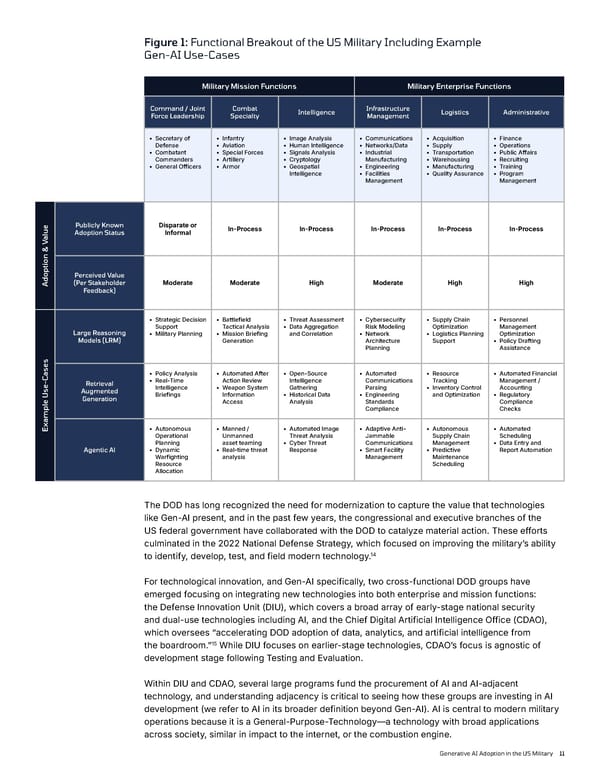
11 Figure 1: Functional Breakout of the US Military Including Example Gen-AI Use-Cases The DOD has long recognized the need for modernization to capture the value that technologies like Gen-AI present, and in the past few years, the congressional and executive branches of the US federal government have collaborated with the DOD to catalyze material action. These efforts culminated in the 2022 National Defense Strategy, which focused on improving the military’s ability to identify, develop, test, and field modern technology.14 For technological innovation, and Gen-AI specifically, two cross-functional DOD groups have emerged focusing on integrating new technologies into both enterprise and mission functions: the Defense Innovation Unit (DIU), which covers a broad array of early-stage national security and dual-use technologies including AI, and the Chief Digital Artificial Intelligence Office (CDAO), which oversees “accelerating DOD adoption of data, analytics, and artificial intelligence from the boardroom.”15 While DIU focuses on earlier-stage technologies, CDAO’s focus is agnostic of development stage following Testing and Evaluation. Within DIU and CDAO, several large programs fund the procurement of AI and AI-adjacent technology, and understanding adjacency is critical to seeing how these groups are investing in AI development (we refer to AI in its broader definition beyond Gen-AI). AI is central to modern military operations because it is a General-Purpose-Technology—a technology with broad applications across society, similar in impact to the internet, or the combustion engine. Generative AI Adoption in the US Military Military Mission Functions Military Enterprise Functions Command / Joint Force Leadership Combat Specialty Intelligence Infrastructure Management Logistics Administrative • Secretary of Defense • Combatant Commanders • General Officers • Infantry • Aviation • Special Forces • Artillery • Armor • Image Analysis • Human Intelligence • Signals Analysis • Cryptology • Geospatial Intelligence • Communications • Networks/Data • Industrial Manufacturing • Engineering • Facilities Management • Acquisition • Supply • Transportation • Warehousing • Manufacturing • Quality Assurance • Finance • Operations • Public Affairs • Recruiting • Training • Program Management Adoption & Value Publicly Known Adoption Status Disparate or Informal In-Process In-Process In-Process In-Process In-Process Perceived Value (Per Stakeholder Feedback) Moderate Moderate High Moderate High High Example Use-Cases Large Reasoning Models (LRM) • Strategic Decision Support • Military Planning • Battlefield Tactical Analysis • Mission Briefing Generation • Threat Assessment • Data Aggregation and Correlation • Cybersecurity Risk Modeling • Network Architecture Planning • Supply Chain Optimization • Logistics Planning Support • Personnel Management Optimization • Policy Drafting Assistance Retrieval Augmented Generation • Policy Analysis • Real-Time Intelligence Briefings • Automated After Action Review • Weapon System Information Access • Open-Source Intelligence Gathering • Historical Data Analysis • Automated Communications Parsing • Engineering Standards Compliance • Resource Tracking • Inventory Control and Optimization • Automated Financial Management / Accounting • Regulatory Compliance Checks Agentic Al • Autonomous Operational Planning • Dynamic Warfighting Resource Allocation • Manned / Unmanned asset teaming • Real-time threat analysis • Automated Image Threat Analysis • Cyber Threat Response • Adaptive Anti- Jammable Communications • Smart Facility Management • Autonomous Supply Chain Management • Predictive Maintenance Scheduling • Automated Scheduling • Data Entry and Report Automation
 Generative AI Adoption in the US Military Page 10 Page 12