
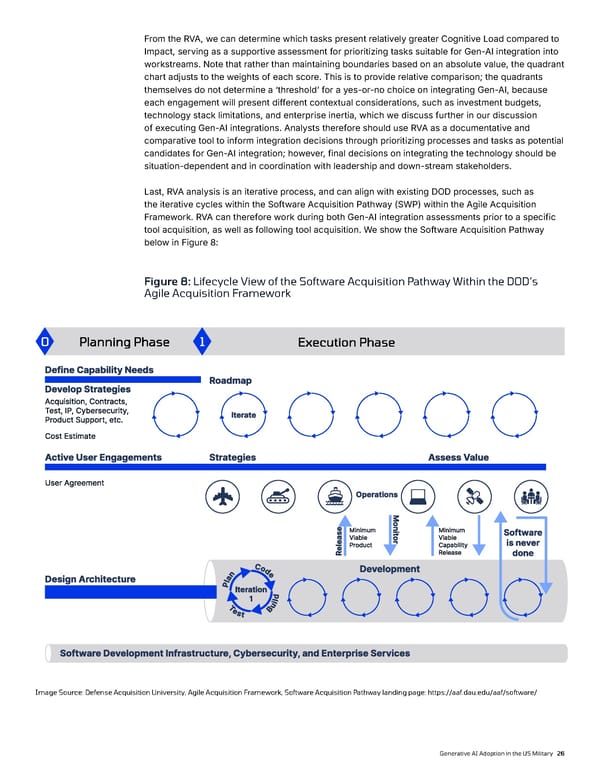
26 From the RVA, we can determine which tasks present relatively greater Cognitive Load compared to Impact, serving as a supportive assessment for prioritizing tasks suitable for Gen-AI integration into workstreams. Note that rather than maintaining boundaries based on an absolute value, the quadrant chart adjusts to the weights of each score. This is to provide relative comparison; the quadrants themselves do not determine a ‘threshold’ for a yes-or-no choice on integrating Gen-AI, because each engagement will present different contextual considerations, such as investment budgets, technology stack limitations, and enterprise inertia, which we discuss further in our discussion of executing Gen-AI integrations. Analysts therefore should use RVA as a documentative and comparative tool to inform integration decisions through prioritizing processes and tasks as potential candidates for Gen-AI integration; however, final decisions on integrating the technology should be situation-dependent and in coordination with leadership and down-stream stakeholders. Last, RVA analysis is an iterative process, and can align with existing DOD processes, such as the iterative cycles within the Software Acquisition Pathway (SWP) within the Agile Acquisition Framework. RVA can therefore work during both Gen-AI integration assessments prior to a specific tool acquisition, as well as following tool acquisition. We show the Software Acquisition Pathway below in Figure 8: Figure 8: Lifecycle View of the Software Acquisition Pathway Within the DOD’s Agile Acquisition Framework Image Source: Defense Acquisition University, Agile Acquisition Framework, Software Acquisition Pathway landing page: https://aaf.dau.edu/aaf/software/ Generative AI Adoption in the US Military
 Generative AI Adoption in the US Military Page 25 Page 27