
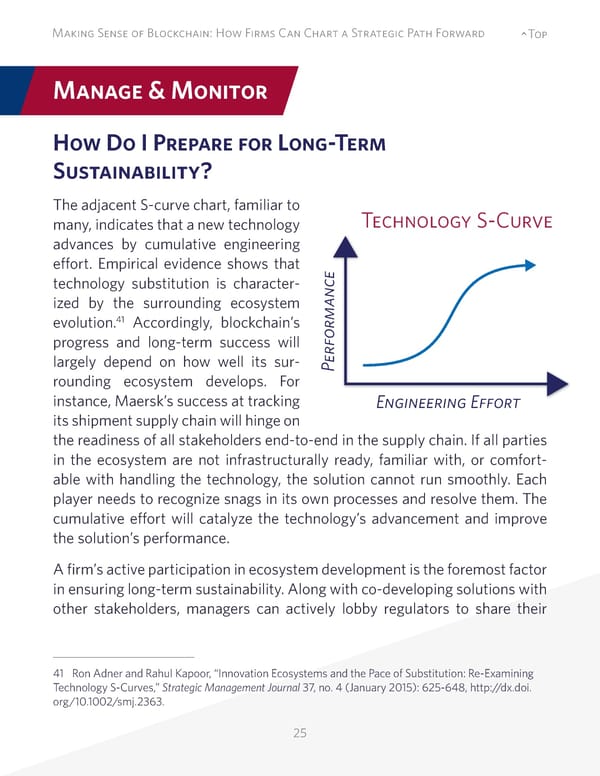
25 Making Sense of Blockchain: How Firms Can Chart a Strategic Path Forward ^Top Manage & Monitor How Do I Prepare for Long-Term Sustainability? The adjacent S-curve chart, familiar to many, indicates that a new technology advances by cumulative engineering effort. Empirical evidence shows that technology substitution is character- ized by the surrounding ecosystem evolution.41 Accordingly, blockchain’s progress and long-term success will largely depend on how well its sur- rounding ecosystem develops. For instance, Maersk’s success at tracking its shipment supply chain will hinge on the readiness of all stakeholders end-to-end in the supply chain. If all parties in the ecosystem are not infrastructurally ready, familiar with, or comfort- able with handling the technology, the solution cannot run smoothly. Each player needs to recognize snags in its own processes and resolve them. The cumulative effort will catalyze the technology’s advancement and improve the solution’s performance. A firm’s active participation in ecosystem development is the foremost factor in ensuring long-term sustainability. Along with co-developing solutions with other stakeholders, managers can actively lobby regulators to share their 41 Ron Adner and Rahul Kapoor, “Innovation Ecosystems and the Pace of Substitution: Re-Examining Technology S-Curves,” Strategic Management Journal 37, no. 4 (January 2015): 625-648, http://dx.doi. org/10.1002/smj.2363. Technology S-Curve Engineering Effort Performance
 Making Sense of Blockchain: How Firms Can Chart a Strategic Path Forward Page 24 Page 26