
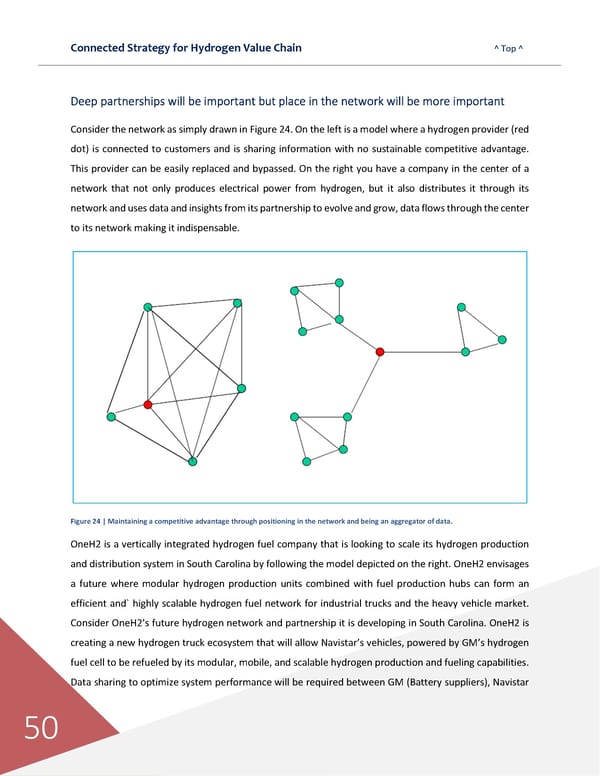
Connected Strategy for Hydrogen Value Chain ^ Top ^ 50 Deep partnerships will be important but place in the network will be more important Consider the network as simply drawn in Figure 24. On the left is a model where a hydrogen provider (red dot) is connected to customers and is sharing information with no sustainable competitive advantage. This provider can be easily replaced and bypassed. On the right you have a company in the center of a network that not only produces electrical power from hydrogen, but it also distributes it through its network and uses data and insights from its partnership to evolve and grow, data flows through the center to its network making it indispensable. Figure 24 | Maintaining a competitive advantage through positioning in the network and being an aggregator of data. OneH2 is a vertically integrated hydrogen fuel company that is looking to scale its hydrogen production and distribution system in South Carolina by following the model depicted on the right. OneH2 envisages a future where modular hydrogen production units combined with fuel production hubs can form an efficient and` highly scalable hydrogen fuel network for industrial trucks and the heavy vehicle market. Consider OneH2’s future hydrogen network and partnership it is developing in South Carolina. OneH2 is creating a new hydrogen truck ecosystem that will allow Navistar’s vehicles, powered by GM’s hydrogen fuel cell to be refueled by its modular, mobile, and scalable hydrogen production and fueling capabilities. Data sharing to optimize system performance will be required between GM (Battery suppliers), Navistar
 Connected Strategies for the Hydrogen Value Chain Page 50 Page 52