
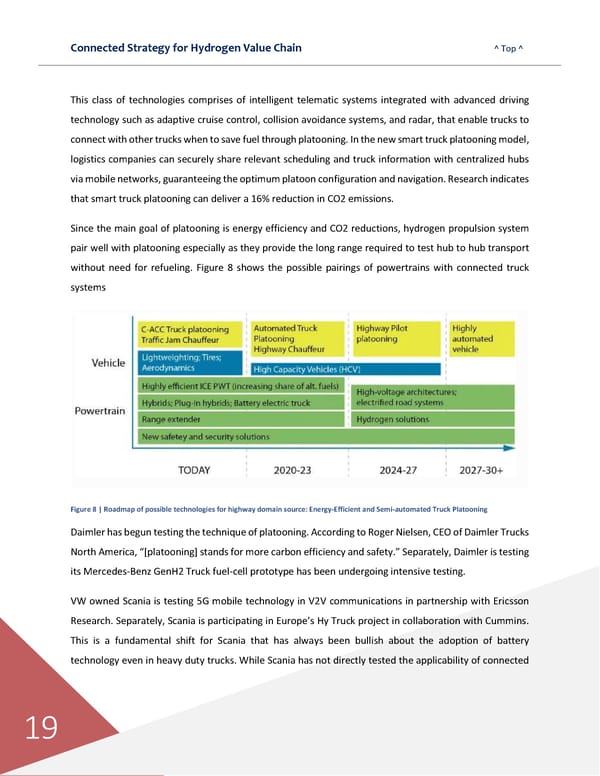
Connected Strategy for Hydrogen Value Chain ^ Top ^ 19 This class of technologies comprises of intelligent telematic systems integrated with advanced driving technology such as adaptive cruise control, collision avoidance systems, and radar, that enable trucks to connect with other trucks when to save fuel through platooning. In the new smart truck platooning model, logistics companies can securely share relevant scheduling and truck information with centralized hubs via mobile networks, guaranteeing the optimum platoon configuration and navigation. Research indicates that smart truck platooning can deliver a 16% reduction in CO2 emissions. Since the main goal of platooning is energy efficiency and CO2 reductions, hydrogen propulsion system pair well with platooning especially as they provide the long range required to test hub to hub transport without need for refueling. Figure 8 shows the possible pairings of powertrains with connected truck systems Figure 8 | Roadmap of possible technologies for highway domain source: Energy-Efficient and Semi-automated Truck Platooning Daimler has begun testing the technique of platooning. According to Roger Nielsen, CEO of Daimler Trucks North America, “[platooning] stands for more carbon efficiency and safety.” Separately, Daimler is testing its Mercedes-Benz GenH2 Truck fuel-cell prototype has been undergoing intensive testing. VW owned Scania is testing 5G mobile technology in V2V communications in partnership with Ericsson Research. Separately, Scania is participating in Europe’s Hy Truck project in collaboration with Cummins. This is a fundamental shift for Scania that has always been bullish about the adoption of battery technology even in heavy duty trucks. While Scania has not directly tested the applicability of connected
 Connected Strategies for the Hydrogen Value Chain Page 19 Page 21