
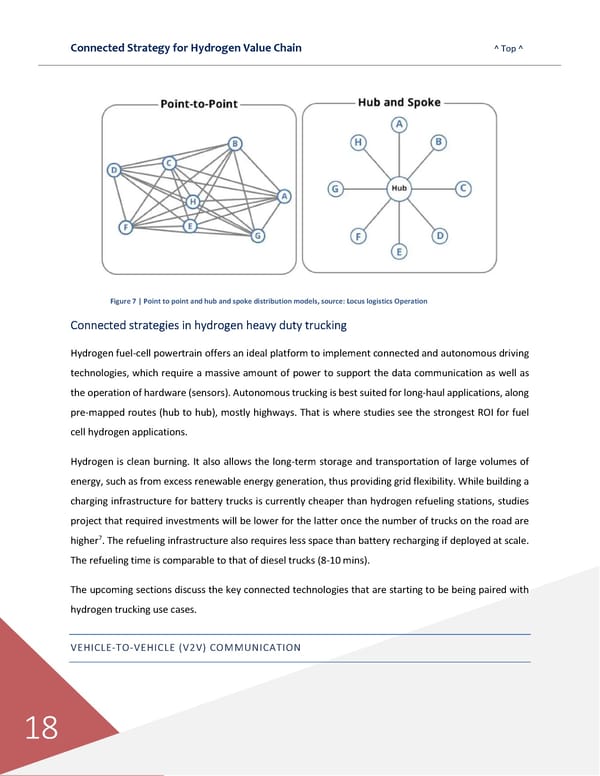
Connected Strategy for Hydrogen Value Chain ^ Top ^ 18 Figure 7 | Point to point and hub and spoke distribution models, source: Locus logistics Operation Connected strategies in hydrogen heavy duty trucking Hydrogen fuel-cell powertrain offers an ideal platform to implement connected and autonomous driving technologies, which require a massive amount of power to support the data communication as well as the operation of hardware (sensors). Autonomous trucking is best suited for long-haul applications, along pre-mapped routes (hub to hub), mostly highways. That is where studies see the strongest ROI for fuel cell hydrogen applications. Hydrogen is clean burning. It also allows the long-term storage and transportation of large volumes of energy, such as from excess renewable energy generation, thus providing grid flexibility. While building a charging infrastructure for battery trucks is currently cheaper than hydrogen refueling stations, studies project that required investments will be lower for the latter once the number of trucks on the road are higher7. The refueling infrastructure also requires less space than battery recharging if deployed at scale. The refueling time is comparable to that of diesel trucks (8-10 mins). The upcoming sections discuss the key connected technologies that are starting to be being paired with hydrogen trucking use cases. VEHICLE-TO-VEHICLE (V2V) COMMUNICATION
 Connected Strategies for the Hydrogen Value Chain Page 18 Page 20