
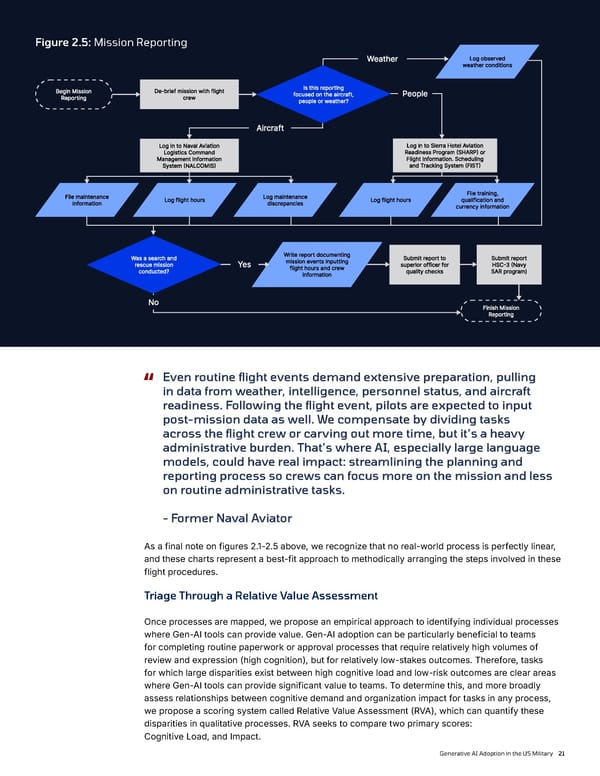
21 Figure 2.5: Mission Reporting Even routine flight events demand extensive preparation, pulling in data from weather, intelligence, personnel status, and aircraft readiness. Following the flight event, pilots are expected to input post-mission data as well. We compensate by dividing tasks across the flight crew or carving out more time, but it’s a heavy administrative burden. That’s where AI, especially large language models, could have real impact: streamlining the planning and reporting process so crews can focus more on the mission and less on routine administrative tasks. - Former Naval Aviator “ As a final note on figures 2.1-2.5 above, we recognize that no real-world process is perfectly linear, and these charts represent a best-fit approach to methodically arranging the steps involved in these flight procedures. Triage Through a Relative Value Assessment Once processes are mapped, we propose an empirical approach to identifying individual processes where Gen-AI tools can provide value. Gen-AI adoption can be particularly beneficial to teams for completing routine paperwork or approval processes that require relatively high volumes of review and expression (high cognition), but for relatively low-stakes outcomes. Therefore, tasks for which large disparities exist between high cognitive load and low-risk outcomes are clear areas where Gen-AI tools can provide significant value to teams. To determine this, and more broadly assess relationships between cognitive demand and organization impact for tasks in any process, we propose a scoring system called Relative Value Assessment (RVA), which can quantify these disparities in qualitative processes. RVA seeks to compare two primary scores: Cognitive Load, and Impact. Figure 2.5: Mission Reporting Generative AI Adoption in the US Military
 Generative AI Adoption in the US Military Page 20 Page 22