
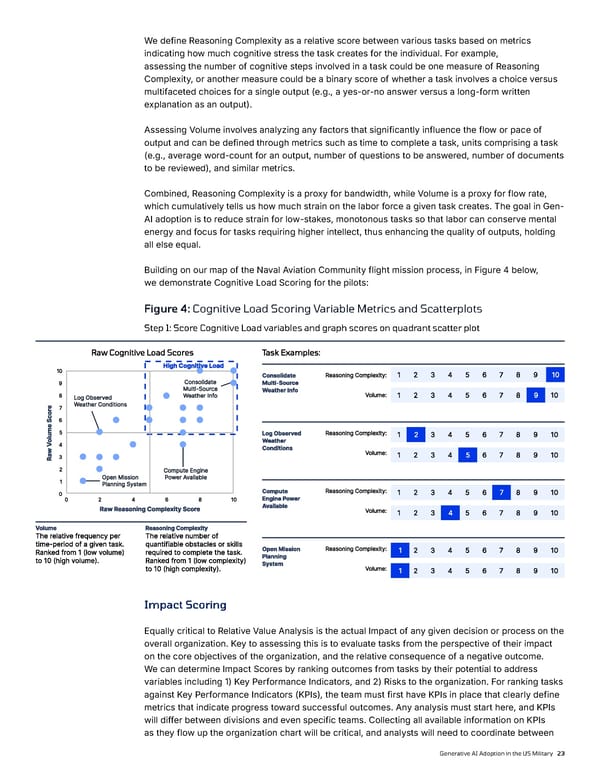
23 We define Reasoning Complexity as a relative score between various tasks based on metrics indicating how much cognitive stress the task creates for the individual. For example, assessing the number of cognitive steps involved in a task could be one measure of Reasoning Complexity, or another measure could be a binary score of whether a task involves a choice versus multifaceted choices for a single output (e.g., a yes-or-no answer versus a long-form written explanation as an output). Assessing Volume involves analyzing any factors that significantly influence the flow or pace of output and can be defined through metrics such as time to complete a task, units comprising a task (e.g., average word-count for an output, number of questions to be answered, number of documents to be reviewed), and similar metrics. Combined, Reasoning Complexity is a proxy for bandwidth, while Volume is a proxy for flow rate, which cumulatively tells us how much strain on the labor force a given task creates. The goal in Gen- AI adoption is to reduce strain for low-stakes, monotonous tasks so that labor can conserve mental energy and focus for tasks requiring higher intellect, thus enhancing the quality of outputs, holding all else equal. Building on our map of the Naval Aviation Community flight mission process, in Figure 4 below, we demonstrate Cognitive Load Scoring for the pilots: Figure 4: Cognitive Load Scoring Variable Metrics and Scatterplots Impact Scoring Equally critical to Relative Value Analysis is the actual Impact of any given decision or process on the overall organization. Key to assessing this is to evaluate tasks from the perspective of their impact on the core objectives of the organization, and the relative consequence of a negative outcome. We can determine Impact Scores by ranking outcomes from tasks by their potential to address variables including 1) Key Performance Indicators, and 2) Risks to the organization. For ranking tasks against Key Performance Indicators (KPIs), the team must first have KPIs in place that clearly define metrics that indicate progress toward successful outcomes. Any analysis must start here, and KPIs will differ between divisions and even specific teams. Collecting all available information on KPIs as they flow up the organization chart will be critical, and analysts will need to coordinate between Step 1: Score Cognitive Load variables and graph scores on quadrant scatter plot Generative AI Adoption in the US Military
 Generative AI Adoption in the US Military Page 22 Page 24