

When Goliath Needs David: Redefining Corporate Venturing
This report explores how corporations and startups are reshaping corporate venturing strategies.
2025 Corporate Venturing Report by Gary Dushnitsky Claudio Garcia Serguei Netessine Valery Yakubovich How Corporations and Startups Are Redefining Corporate Venturing When Goliath Needs David
About The Mack Institute for Innovation Management at the Wharton School at the University of Pennsylvania The Mack Institute for Innovation Management supports Wharton faculty research on innovation and entrepreneurship and translates it into experiential learning for students and actionable insights for business. By fostering collaboration among researchers, students, and industry leaders, the institute serves as a hub where academic discovery meets real-world application. Through cutting-edge research, hands-on student engagement, and dynamic events, the Mack Institute helps organizations navigate the risks and opportunities of emerging technologies and innovation-driven change. Recommended citation: This report should be cited as: Dushnitsky, Gary; Claudio Garcia, Serguei Netessine, Valery Yakubovich. (2025). Corporate Venturing Report. Mack Institute for Innovation Management at The Wharton School. Please use this citation format when referencing this report in publications, presentations, or academic work. If citing in a different format, please retain the full author and publication details provided above.
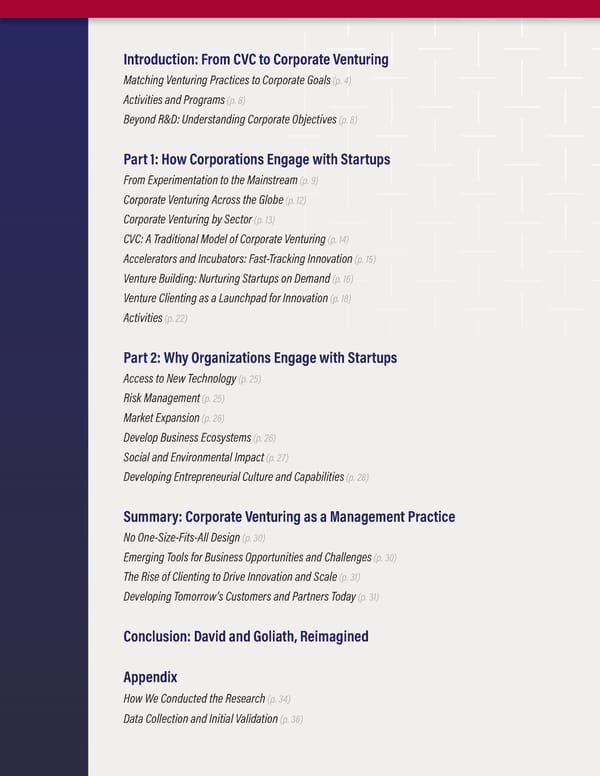
Introduction: From CVC to Corporate Venturing Matching Venturing Practices to Corporate Goals (p. 4) Activities and Programs (p. 8) Beyond R&D: Understanding Corporate Objectives (p. 8) Part 1: How Corporations Engage with Startups From Experimentation to the Mainstream (p. 9) Corporate Venturing Across the Globe (p. 12) Corporate Venturing by Sector (p. 13) CVC: A Traditional Model of Corporate Venturing (p. 14) Accelerators and Incubators: Fast-Tracking Innovation (p. 15) Venture Building: Nurturing Startups on Demand (p. 16) Venture Clienting as a Launchpad for Innovation (p. 18) Activities (p. 22) Part 2: Why Organizations Engage with Startups Access to New Technology (p. 25) Risk Management (p. 25) Market Expansion (p. 26) Develop Business Ecosystems (p. 26) Social and Environmental Impact (p. 27) Developing Entrepreneurial Culture and Capabilities (p. 28) Summary: Corporate Venturing as a Management Practice No One-Size-Fits-All Design (p. 30) Emerging Tools for Business Opportunities and Challenges (p. 30) The Rise of Clienting to Drive Innovation and Scale (p. 31) Developing Tomorrow’s Customers and Partners Today (p. 31) Conclusion: David and Goliath, Reimagined Appendix How We Conducted the Research (p. 34) Data Collection and Initial Validation (p. 36)
4 J ust a few years ago, the prevailing narrative painted startups as Davids to corporate Goliaths — nimble disruptors poised to topple established giants. More recently, market volatility associated with increases in inflation and interest rates has flipped this dynamic. The reduced risk appetite of venture capitalists and other investors has significantly impacted startup funding, leading to significant valuation corrections, fewer liquidity opportunities, and a change of focus to profitability and sustainable growth over rapid scaling at all costs. In the context of today’s high tech, such a change requires deep pockets and big clients. No wonder startups are seeking creative ways to engage with corporations which, in turn, seized this opportunity to address their strategic priorities. The recent story of Microsoft investing nearly $14B into OpenAI and integrating it into its applications has reverberated across the tech community and inspired many similar alliances. Introduction: From CVC to Corporate Venturing
5 The insight that collaboration — rather than disrup- tion — characterizes corporate-startup relationships is not new. The term “Open Innovation” was first coined at the turn of the 21st century to denote the dramatic rise in the number of leading corporations advancing their innovation goals through engage- ments with external audiences, including startups. The trend was boosted by the fact that many of the largest corporations today, including Amazon, Meta, Tesla, and Google, were themselves small startups just a couple of decades ago. Now, 25 years into this century, we have an opportunity to take stock and assess corporations’ experience with various venturing strategies. Indeed, our research has noted substantial diversification of corporation- startup collaborations and, perhaps most notably, a greater variety of strategic objectives behind them. Far from adversaries, corporations and startups are increasingly becoming indispensable allies, forging a variety of arrangements that blend the agility of the former with the scale and resources of the latter. It’s a landscape rich with potential, where innovation no longer resides solely within the walls of corporate R&D labs or in the garages of entrepreneurial dreamers but thrives in the new spaces where the two worlds mingle. Collectively, we refer to these practices as Corporate Venturing — the deliberate effort by corporations to create structures that harness startups’ capabilities in pursuit of strategic business objectives. This report presents the results of the Mack Institute’s study of the corporate venturing practices of the world’s 500 largest companies from the Forbes 2023 Global 2000 List, described in their annual reports and on corporate websites as of January 2024 (see the Appendix beginning on page 34 for details). We undertook this project to show the variety of ways in which corporations are scaling and broadening their interactions with startups. Below are just a few anecdotes that illustrate the diversity of emerging symbiotic relationships. These stories, among many others, illustrate how corporations and startups see each other today: not exclusively as rivals or investment opportunities but as complementary forces to manage and work alongside. Together, they are working to shape a future that neither David nor Goliath could achieve alone. For corporations seeking to design or refine their startup engagement strategies, the report offers a valuable compass for navigating an increasingly sophisticated landscape. For entrepreneurs, it offers insight into the corporate approach to innovation and how startups fit into it.
Total Energies, a French energy conglomerate, is an example of using corporate venturing to achieve social or environmental impact. Their $400 million Total Carbon Neutrality Ventures funds startups that work towards lowering emissions. NatWest Group offers entrepreneurs mentor- ing, coaching and workspace access through a fully-funded accelerator program. This connects the UK-based financial institution to the next wave of innovators and ensures their place in the fabric of the British entrepreneurial ecosystem. Nvidia is one of a number of companies building its own ecosystems: its Inception for Startups program has a network of almost twenty thousand startups. This is a departure from the VC model of betting on a small port- folio of startups in the hopes of hitting it big. BBVA, a digital banking company, uses corporate venturing to expand into new markets. They have built physical collaboration hubs called “Open Spaces” across Mexico, allowing them to collaborate with local entrepreneurs, thus gaining the upper hand in this emerging market. Johnson & Johnson strategically invested in a Dutch biotech company working on advanced antibody development. Partnering with start- ups allows the healthcare behemoth to access cutting-edge biopharmaceutical technologies. Case Snapshots: Startup–Corporate Symbiosis
7 Matching Venturing Practices to Corporate Goals We have identified eight key corporate venturing practices that the 500 largest global corporations employ in pursuit of six main corporate goals. Notably, these practices are often used in combination with one another, with each company determining its own bundle that best meets its objectives. The Six Key Corporate Objectives: 1. Risk Management 2. Market Expansion 3. Access to New Technology 4. Develop Business Ecosystems 5. Social and Environmental Impact 6. Developing Entrepreneurial Culture and Capabilities The Eight Key Corporate Venturing Practices: 1. Corporate Venture Capital 2. Accelerators and Incubators 3. Venture Building 4. Venture Clienting 5. Mentorship 6. Business Services 7. Workspace 8. Events
8 Beyond R&D: Understanding Corporate Objectives Startup engagement always serves a purpose, but that purpose is evolving. Traditionally, interactions between established firms and innovative startups were seen as a vehicle to benefit financially or drive innovation and adaptation to technological disruptions, often under the umbrella of “Open Innovation.” More recently, corporate venturing has been increas- ingly seen as a key driver of business ecosystems. Unlike a linear supply chain, a company’s business ecosystem is a dynamic network of interdependent players (including suppliers, complementors, and even competitors) who enhance the company’s value proposition. Such ecosystems are reshaping how companies co-create experiences, share risks, and adapt to rapid industry changes. For example, China Mobile leverages strategic equity investments in startups that can strengthen its business ecosys- tem by enhancing customer experiences in critical sectors such as digital intelligence transformation, cloud gaming, digital content, and fintech. The global Visa Fintech Partner Connect program helps clients connect with fintech innovators, fostering its “network of networks” approach and improving digital-first experience. Corporate venturing is also playing a growing role in advancing environmental and social impact initiatives. Examples include Unilever’s TRANSFORM initiative to support visionary impact enterprises, TotalEnergies’ $400 million Total Carbon Neutrality Ventures fund, which is dedicated to carbon neutrality, and United Airlines’ Sustainable Flight Fund, which launched with a $200 million commitment to sustainable aviation. Other corpo- rate venturing activities focus on supporting minority founders or funding environmentally friendly innovations that address major global challenges. Beyond external innovation, corporate venturing has re-emerged as a tool for building internal capabilities. Leading corporations use events, mentorship programs, business services, and work- spaces to blur the lines between intrapreneurship (entrepreneurial initiatives within the company) and entrepreneurship, fostering an innovative culture and attracting entrepreneurial talent. Some compa- nies even acquire startups not just for their products or services but for the expertise and creativity of their teams — a practice known as “acqui-hiring.” Activities and Programs Our analysis, as well as follow-up discussions and presentations to practitioners, suggest that the eight corporate venturing practices can be divided into two categories: Activities and Programs. Activities are narrowly defined stand-alone initiatives that can operate independently, often as entry points into corporate venturing, or support larger programs. These include Mentorship, Business Services, Events, and Workspaces. Programs are structured systems of interconnected activities. These include Corporate Venture Capital (CVC), where companies invest in startups in exchange for equity; Accelerators and Incuba- tors, which provide startups with funding, physical space, human and social capital, and other resources; Venture Building, where corporations create new startups from scratch, either internally or in collaboration with external actors; and Venture Clienting, where corporations become startups’ strategic customers, allowing them to get their products or service off the ground. After introducing and discussing all eight activities and programs, we review Venture Building and Venture Clienting in more detail, as they are relatively new phenomena gaining traction in corporate venturing.
9 Part 1: How Corporations Engage with Startups From Experimentation to the Mainstream According to the 500 largest global companies’ annual reports and websites, corporate venturing is no longer a fringe or experimental pursuit but a fixture of corporate strategy. Most companies have embraced at least one of the eight corporate venturing practices explored in this report. Accelerators and Incubators are the most common corporate venturing practice, closely followed by Corporate Venture Capital (see Figure 1). Over half of the surveyed companies engage in one or both of these two practices. The dominance of Business Services among Activities is not surprising; it is the only practice that does not appear as a constitutive element of the four Programs. Companies mix and match the eight practices in pursuit of one or more corporate objectives. Figure 2 on the next page illustrates how the eight practices contribute to achieving the six most common corporate goals.
10 Companies mix and match the eight practices in pursuit of one or more corporate objectives. Figure 2 illustrates how the eight practices contribute to achieving the six most common corporate goals beyond financial gains. “ Figure 1. Forbes 500 Companies’ Engagement with Corporate Venturing* Engagement (%) Industry 50% 40% 30% 20% 10% 0% Programs Activities 274 282 202 253 208 215 155 114 * The numbers above the bars represent the total number of companies engaged. Corporate Venture Capital Accelerators & Incubators Venture Building Venture Clienting Mentorship Business Services Workspace Events
11 The most versatile practices are CVC, Accelerators and Incubators, Venture Clienting, and Events; they contribute to five out of six corporate goals. By contrast, Mentorship and Workspace are the most focused practices; companies use them to develop their business ecosystems, create social and envi- ronmental impact, and cultivate entrepreneurial cul- ture and capabilities internally. From the corporate objectives’ side, business ecosystems benefit from all eight practices. At the same time, companies man- age risk by using the four venturing programs, which often include mentorship, workspace, and events as activities. The diagram does not list “financial gains,” a well-understood default objective. Figure 2. Combining Venturing Practices in Pursuit of Corporate Objectives Risk Management Corporate Objectives Corporate Venture Capital Corporate Venturing Practices Market Expansion Accelerators & Incubators Access to New Technology Venture Building Develop Business Ecosystems Venture Clienting Social & Environmental Impact Mentorship Developing Entrepreneurial Culture & Capabilities Business Service Workspace Events Activities Programs
12 Corporate Venturing Across the Globe As Figure 3 shows, European companies are the most vocal in communicating their adoption of corporate venturing practices in their annual reports and websites; over 60% of them do so in comparison with about 35% of US and Asian businesses. This raises intriguing questions. Do European companies feel obliged to talk about their commitment to startups, perhaps under pressure from more innovative Amer- ican and Asian competitors and standard setters, who are less compelled to broadcast something the public already knows? Or are the Europeans indeed ahead in embracing these practices to close the innovation gap? While venture capital is much more active in the US and Asia, corporate venturing might be Europe’s best bet to level the playing field. Though we see a significant engagement in Africa, Australia, and South America, the total number of corporations among the Forbes Global 500 in these regions (one, nine, and seven, respectively) is too small for statistical analysis and thus excluded from Figure 3. Figure 3. Forbes 500 Companies’ Engagement with Programs and Activities by Continent* Engagement Rate (%) Continent 80% 60% 40% 20% 0% 142 106 90 104 107 116 Programs Activities North America Europe Asia * The numbers above the bars represent the total number of companies engaged.
Corporate Venturing by Sector We will now offer more detailed descriptions of the eight key corporate venturing practices identified in our research. As previously noted, we classify these practices into two categories: Programs, which serve as the foundation of well-established corporate venturing initiatives, and Activities, stand-alone, entry-level practices or components of those four programs. Among the Programs, Corporate Venture Capital (CVC) is a traditional model of corporate venturing and thus a departure point for our discus- sion, while Venture Building and Venture Clienting are two approaches that, once peripheral and hidden within other programs, are now gaining prominence as corporations expand their venturing playbook. Shifting to industry sectors, we find that the industries leading the charge in corporate venturing are those where innovation and disruption are the most visible today: Technology and Finance, followed by Pharma and Healthcare, and Retail and Trading. Conversely, Transportation and Construction rank the lowest. Figure 4. Forbes 500 Companies’ Engagement with Programs and Activities by Industry* Industry Engagement (%) Transportation Manufacturing Retail & Trading Energy & Utilities Construction Pharma & Healthcare Financial Technology 0% 20% 40% 60% 80% 4 6 37 34 51 23 116 40 8 13 45 43 62 29 120 52 13 * The numbers to the right of the bars represent the total number of companies engaged. Programs Activities
14 CVC: A Traditional Model of Corporate Venturing Corporate Venture Capital (CVC) is the first thing that comes to mind when the topic of corporate venturing is brought up. Under this program, companies leverage their financial resources, industry expertise, and market relationships to invest directly in startups to foster innovation, grow capital, access new markets, and gain competitive advantages. CVC typically involves minority equity investments in startups, allowing corporations to engage with entrepreneurial ecosystems without taking full ownership. Unlike independent venture capital firms, CVC units of publicly traded companies are expected to disclose their investment targets. Investment sizes vary widely, with many corporate venture arms managing portfolios between $50 mil- lion and $200 million. The practice is global in scope. For instance, Alibaba Group’s Ant Financial has invested in fintech startups such as Paytm in India, expanding its digital payments footprint. In Europe, Siemens’ Next47 has invested in startups like Augury, a predictive maintenance company. In the US, Google Ventures (GV) has strategically funded industries ranging from healthcare to AI, with early-stage investments in companies like Uber. The Indian conglomerate Larsen & Toubro (L&T) uses CVC to track emerging technologies while pursuing financial gains. L&T avoids seed-stage investments, preferring startups that have already demonstrated product-market fit and acquired initial customers. Its current focus areas include Enterprise SaaS and DeepTech. Looking at CVC’s prevalence across industries, it becomes clear that it has become a standard practice. Between 50% and 60% of corporations in each sector report engaging in CVC, a remarkable adoption rate given that CVC is the most capital-intensive form of corporate venturing. Key Components of CVC Programs Personnel CVC teams may consist of internal talent drawn from the parent corporation or external experts, such as seasoned venture capitalists and former entrepreneurs with deep knowledge of startup ecosystems. Structure Some CVC programs maintain dedicated, segregated pools of capital exclusively for startup investments, while others operate on a case-by-case approval basis. Governance Investment decisions are generally made by committees comprising senior corporate executives, external advisors, and CVC personnel, balancing strategic objectives with financial returns. Between 50% and 60% of corporations in each sector report engaging in CVC—a remarkable adoption rate for the most capital-intensive form of corporate venturing. “
15 Accelerators and Incubators: Fast-Tracking Innovation Accelerators and incubators are structured programs designed to nurture startups and early-stage businesses by providing financial, human, and social capital. These programs have distinct origins and objectives. Incubators, which date back to the 1950s, were initially established to support local businesses, with the Batavia Industrial Center in New York being one of the first. They typically offer long-term support, focusing on transforming ideas into viable businesses through physical workspaces, operational guidance, and network access. Accelerators, in contrast, gained prominence in the mid-2000s, with Y Combinator (founded in 2005) widely recognized as a pioneering model. These programs are more intensive and short-term, lasting 3-6 months, and aim to help startups scale quickly. They often culminate in a demo day to pitch to investors. Corporations worldwide have embraced accelerators and incubators as core components of their corporate venturing strategies. Data shows an adoption rate of approximately 50%. When successful, they offer unparalleled proximity to startups, providing corporations with deeper insights into emerging ventures’ potential. Additionally, they are often l inked to contractual rights, including discounted ownership costs or collaborative opportunities, which can yield significant strategic rewards. Key Components of Accelerators and Incubators Program Design Accelerators are time-bound, cohort-based initiatives focused on fast-tracking startups through a structured program enhanced by activities such as mentorship, fundraising, and corporate connections. Incubators, in contrast, offer longer-term support and usually provide startups with more resources than accelerators, such as workspace, technical infrastructure and deeper business advisory. Engagement Model Startups in accelerators and incubators often receive structured support and even initial investment in exchange for equity or partnership opportunities. Strategic Alignment Corporations running these programs align startup selection and mentorship with their core business objectives, fostering innovation in targeted areas. Investment and support decisions are typically driven by a combination of corporate leadership, external advisors, available resources and program managers, ensuring that emerging ventures are aligned to long-term strategic goals.
16 Venture Building: Nurturing Startups on Demand Venture building is the process of systematically creating, launching, and scaling new startups within a structured organization. Think of it as a nursery for startups that provides shared resources, capi- tal, and operational support to increase the chances of success. The corporation identifies the domain of interest, and the startups are nurtured either by an internal venture building team, or by an external party, such as a university or a standalone ‘venture studio.’ Ten years ago, venture building was a novelty in the corporate landscape. However, our data suggests that the practice is growing in popularity. According to Figure 1 above, more than 20% of companies in our sample report Venture Building programs. For instance, Airbus created a special unit, Scale, whose mission is “to build and launch new businesses that will support the company’s future growth.” Scale first attracts Airbus’s human and financial resources, but then it seeks external funds and talent to develop the company’s assets and pioneer new markets. Scale aims to spin out viable startups to create established companies that will generate revenue or equity for Airbus, supporting diversification and growth. Takeda Pharmaceutical runs an internal venture program that supports researchers in launching startups, while Société Générale identifies intrapre- neurial talent and helps them develop FinTech start- ups. Academic institutions also play a significant role in venture-building collaborations. Deutsche Post Figure 5. Forbes 500 Companies’ Engagement with Venture Building by Industry* Engagement (%) Industry 40% 20% 25% 30% 35% 15% 10% 5% 0% Construction 7 Manufacturing 26 Pharma & Healthcare 10 Retail & Trading 11 Transportation 2 Technology 13 Financial 25 Energy & Utilities 19 * The numbers above the bars represent the total number of companies engaged.
17 DHL Group partnered with the University of Bonn to develop Greenplan, a route optimization software. Though initially incubated within DHL, Greenplan was later spun out as a management-owned startup, demonstrating how venture building can transform ideas into independent businesses. General Mills formed a venture team, supported by a growth board, to explore consumer food-related challenges. This team conducted extensive experi- mentation before successfully scaling the most prom- ising solutions globally. Figure 5 suggests high engagement in venture building, more than 30%. But, in contrast from most Programs and Activities (which follow the overall engagement seen in Figure 4), the highest industry engagements for venture building are Construction, Manufacturing, and Energy and Utilities. Significant capital needs in those industries, combined with relatively low interest from entrepreneurs and VCs compared to high-tech, prompt corporations to step in. Key Components of Venture Building Programs Decision Model Organizations pursue venture building when they identify strategic gaps that cannot be addressed through tradi- tional M&A or external partnerships. Decisions to launch new ventures are typically based on market trends, emerging technologies, or internal innovation roadmaps. Corporate leadership, innovation teams, and external advisors assess feasibility, potential synergies, and long- term scalability before committing resources. Operational Integration New ventures often start as independent entities but maintain strong ties to the parent corporation. They may leverage corporate infrastructure, talent, and market access while operating with the agility of a startup. Over time, successful ventures may be fully integrated into the company or spun off as independent businesses. Governance & Scalability Venture building requires a structured governance mod- el where corporate leadership, venture teams, and ex- ternal partners collaborate to drive growth without the constraints of the established business. Investment decisions are made with a long-term strategic focus, balancing risk with potential market impact. Scalability depends on internal resource allocation, market vali- dation, and the ability to attract external funding as the venture matures. Ten years ago, venture building was a novelty in the corporate landscape. However, our data suggests that the practice is growing in popularity. “
18 Venture Clienting as a Launchpad for Innovation Staying ahead in our fast-changing business world requires large organizations to adopt and implement innovations faster and cheaper than traditional CVC allows. Venture clienting has emerged as a key tool for doing so. It offers corporations a fast, cost- effective, and lower-risk pathway to test new technol- ogies, bring them to markets, and capture value from innovation. Unlike CVC, which involves financial stakes and requires patience as startups scale, or Accelerators and Incubators, which require physical, human and social capital, Venture clienting limits financial exposure by structuring engagements as procurement contracts rather than equity investments, avoiding the risks associated with venture capital portfolios. This flexibility allows firms to pilot multiple solutions and scale only those that prove effective. Additionally, venture clienting often proves more cost-efficient than in-house development, enabling companies to access cutting-edge capabilities without the heavy R&D investment required to build them internally. Our research shows that approximately 40% of the analyzed companies engage with startups as clients. For example, BMW adopts startups as suppliers, integrating their technologies (such as advanced sensors and artificial intelligence) into their vehicles. According to the company, this model has proven transformative, enabling advancements in auton- omous driving and connected vehicles. The BMW Garage has therefore become a model in Venturing Clienting success, exemplifying how corporations can derive substantial innovation benefits without taking equity. In another example, Bosch’s Open Bosch initiative takes advantage of venture clienting as a contribution to its innovation pipeline, introducing startup- driven solutions to the market at scale in areas like IoT, mobility, and energy. This initiative underscores the role of venture clienting in efficiently addressing complex technological challenges. Through Store No. 8, a technology incubator fostering innovation in retail, Walmart collaborates with startups to pilot and implement new technolo- gies in its stores, effectively serving as a venture client to these emerging companies. Venture clienting is beneficial for startups as well. It provides critical market validation and non- dilutive, revenue-based cash flow. However, this model is not without its challenges. Integrating a startup’s solutions into a large corporation’s infrastructure can be complex. Resource constraints on the startup’s side may lead to scalability issues, while differences in organizational cultures and engagement speeds can further complicate collaborations. Venture clienting offers corporations a fast, cost-effective, and lower-risk pathway to test new technologies and capture value from innovation. “
19 Key Challenges For Venture Clienting Cultural Differences The cultural gap between large corporations and agile startups is often substantial. While corporations may operate within structured processes and hierarchy, start- ups are typically more flexible and less formal. Managing this cultural divide requires open communication, mutual understanding, and sometimes the involvement of a dedicated team to bridge operational styles. Scalability Concerns Corporations may find that a promising solution from a startup doesn’t scale as expected to meet their full requirements. To address scalability challenges, corporations can conduct a scalability assessment during pilot projects to ensure the solution can meet operational demands. Intellectual Property and Confidentiality Protecting intellectual property and sensitive data is essential when working with external startups. The ability to effectively integrate and work with startups calls for a two-way communication of confidential intellectual property and data. Clear legal agreements regarding IP rights, data protection, and confidentiality help build trust and safeguard both parties’ interests. Key Components of Venture Clienting Programs Strategic Needs First, the corporation assesses areas of opportunity or challenges where external solutions would add value. Startup Scouting Based on the aforementioned needs, the corporation undertakes scouting efforts to discover relevant startups that offer innovative solutions. This process can be facil- itated through networks, accelerator programs, industry events, and online platforms. Corporations may also use scouting tools to filter startups based on relevance, innovation potential, and scalability. Pilot Projects With a handful of the scouted startups, the corporation proceeds to conduct small-scale pilot projects. The goal is to assess the startup’s solution in a controlled environment that allows testing functionality and integration without committing significant resources. Corporations can then evaluate the solution’s perfor- mance and feasibility before making larger investments. For instance, a retail company might pilot a new inventory management system in a single store. Scaling Successful Solutions Once a solution has proven its value and compatibility in the pilot, it can be scaled across the organization. This step often involves allocating additional resources and setting up a dedicated implementation team to ensure smooth deployment across different units or locations.
20 Regarding adoption numbers by industry, we see stark differences between venture building and venture clienting (see Figure 6). While Construction and Manufacturing led in Venture Building, we see that the Financial industry, Retail and Trading, and Technology lead in Venture Clienting, with adoption by almost 50% of the companies. It is curious to note a relatively high engagement by Transportation companies and very low engagement by Construction companies, the exact opposite of Venture Building. To summarize, the four Corporate Venturing Programs vary in structure, time horizon, investment requirements, risk exposure, and strategic impact. For companies designing their approach, these distinctions are critical, as they directly influence out- comes and long-term value creation. Table 1 provides a comparative overview of the four programs, highlighting their key differentiators and strategic implications. Figure 6. Forbes 500 Companies’ Engagement with Venture Clienting by Industry* Engagement (%) Industry 50% 20% 30% 40% 10% 0% Technology Retail & Trading Financial Transportation Manufacturing Pharma & Healthcare Energy & Utilities Construction 28 28 6 12 3 31 19 72 * The numbers above the bars represent the total number of companies engaged.
21 Table 1. Comparative Overview among the 4 Corporate Venturing Programs FEATURE Corporate Venture Capital (CVC) Accelerators & Incubators Venture Building Venture Clienting PURPOSE To gain financial returns and strategic benefits by investing in startups To initiate and fast-track the growth of startups through structured steps To create new ventures internally to explore new business opportunities To procure innovative solutions as a customer FUNDING TYPE Equity-based investment Physical, human, and social capital. Companies might ask for equity in exchange for participation Internal funding No funding is expected FINANCIAL RISK High, due to equity investment Low-to-moderate financial risk; costs are tied to running the program rather than direct investment High, as it involves resource-intensive internal development Minimal financial risk; costs limited to procurement ENGAGEMENT WITH STARTUPS Startup is seen as a financial asset and a strategic partner Startups receive structured support through a standard program The venture is created and owned by the corporation The startup is treated as a supplier and strategic partner TIME HORIZON Medium to long. Realizing returns and strategic impact may take years, as it requires startups to scale Short (Accelerators) to medium (Incubator). Startups then, either scale or pivot Medium to long. Startups need time to establish, develop, and scale Short to medium. Solutions are implemented rapidly, within a few quarters EXIT STRATEGY Often seeks an exit (e.g., IPO or acquisition) to realize returns No direct exit strategy; corporations may form partnerships or later invest in promising startups No exit; ventures either become independent businesses or are integrated back into the corporation No exit required; solutions are implemented or dropped based on performance SCALABILITY Scalability depends on the financial and strategic success of invested startups Scalability depends on the number of startups a corporation can support in each cohort Scalability is limited by internal resources and the time it takes to develop and grow new ventures High scalability, as corporations can implement multiple solutions from various startups
22 Activities For organizations new to corporate venturing, there is no need to commit to complex, resource- intensive initiatives immediately. Instead, start with lower-cost, less complex approaches that offer a faster learning curve and tangible benefits before scaling into more comprehensive strategies. These entry-level practices can also serve as valuable components within more structured corporate venturing frameworks and programs discussed above. Table 2 lists the four key activities we identi- fied, accompanied by examples drawn from our data. Table 2. Corporate Venturing Activities ACTIVITY DEFINITION WHEN TO USE IT REAL WORLD EXAMPLES Mentorship Corporate executives and their teams and partners provide guidance, knowledge, and connections to startup founders. When the goal is to build relationships with startups and expose them to industry-specific expertise, critical networks, and capabilities that might otherwise take years to develop independently. Reliance Industries, through its JioGenNext program supported hundreds of startups through mentorship focused on exploring opportunities within the organization’s ecosystem. Itochu’s Kakusei program provides startups with mentorship in global fundraising and business expansion, helping the company to identify and nurture high-potential ventures that align with its strategic interests. Koç Holding Startups women innovators program provided one-to-one mentoring support in leadership, business development, impact and behavioral insight to women founders. Business Services Corporations customize their products and services to startups’ needs and financial constraints. When a corporation wants to develop specific business lines dedicated to startups and enter the market for small businesses while learning about new technologies. India’s HDFC Bank designed Smartup Solution, a banking package for startups, which offers tailor made banking and advisory services to entrepre- neurs. The package is tailored to meet startups’ requirements and includes banking and payment solutions along with advisory and forex services. Microsoft, Amazon and Google invite startups to their clouds with pro-bono or heavily subsidized computing services: Microsoft for Startups, Grow Your Startup with AWS, and the Google for Startups Cloud Program, respectively. Comcast offers startups a Unified Communication as a Service (UCaaS) whose affordability was critical for small businesses’ survival in the aftermath of COVID-19 when remote work became commonplace.
23 Table 2. Corporate Venturing Activities (Continued) ACTIVITY DEFINITION WHEN TO USE IT REAL WORLD EXAMPLES Shared Workspaces Corporations create physical or virtual spaces for startups to work alongside corporate employees and external partners, encouraging idea exchange and collaboration. Often used as a component under the umbrella of “open innovation.” It is helpful for fostering collaboration between startups and corporate teams, especially in R&D or ecosystem development contexts and saves costs of rent and equipment. Vinci coworking hub in Paris provides space for employees, entrepreneurs, local authorities, and civil society representatives to meet and collaborate. Walt Disney’s Accelerator pairs a coworking space with mentorship from top executives and opportunities for collaboration across the company’s divisions. Brazilian Banco Bradesco, through its InovaBra innovation lab, offers physical and digital spaces for participating startups. Events Corporations host or participate in startup- targeting events such as hackathons, pitch competitions, demo days, or networking sessions. Initial low-risk contact with entrepreneurial talent and fresh ideas. Opportunity to learn and explore partnerships with no strings attached. Exposure to entrepreneurial ecosystems. Opportunity to identify and explore technological trends and establish relationships with entrepreneurial talent. Volkswagen’s Startup Challenge invites startups to develop digital factory solutions for manufacturing, tapping into specialized insights to tackle innovative, practical applications. BASF Plug and Play events connect the company with startups focusing on sustainable chemistry. Unilever Innovation Days allow the company to connect with startups from various regions, enabling them to gain firsthand knowledge of local consumer behavior. Schneider Electric participates in startup pitch events to identify energy management and automation ventures.
24 Part 2: Why Corporations Engage with Startups E ngagement with startups allows established companies to address an array of corporate objectives. Beyond the default objective of financial gains, our study identified six key objectives which are explored below and illustrated with examples from our data. The objectives are ordered by the extent of their association with corporate venturing as commonly understood. The first three — Access to New Technology, Risk Management, and Market Expansion — are conventional goals of corporate venturing. The other three corporate objectives — Developing Business Ecosystems, Social and Environmental Impact, and Developing Entrepre- neurial Culture and Capabilities — usually imply other means. Their appearance here demonstrates how corporate venturing is evolving into a broad- er strategic tool, extending far beyond its original conception.
25 Access to New Technology Startups are often the source of cutting-edge technol- ogies. Whether focused on AI, IoT, or digital appli- cations, corporate venturing practices allow corpo- rations to explore, test, and potentially adopt such innovations rapidly. At the same time, corporate partnerships can grant startups the resources and market access they need for accelerated development and growth. ABB, for instance, collaborates with technology start- ups to develop advanced digital solutions tailored to customer needs. This approach helps ABB expand its portfolio and maintain a competitive edge in auto- mation and digital transformation. Adobe’s expan- sion into 3D and immersive technologies illustrates how partnering with startups can secure long-term technological leadership. Meanwhile, Airbus has established a Cyber Innova- tion Center in Newport, Wales, as part of a broader innovation ecosystem that includes research initiatives, incubators, and accelerators. Through this network, Airbus leverages startups to advance its cybersecurity capabilities, meeting rising demands for connectivity in an increasingly digital world. Indian conglomerate Larsen & Toubro achieves access to new technology goals through its CVC unit, which invests in startups after they demonstrate product-market fit and attract the first customers. Risk Management One of the foremost challenges facing large corpo- rations today is the need to react swiftly to critical risks like market disruptions and technological shifts. Since startups offer lean structures and a reputation for rapid innovation, corporations often target them to avoid being overtaken by emerging technologies and other innovations. For example, Cisco Systems recognizes that competition with startups is inevitable and stra- tegically invests in early-stage technologies. Verizon Communications, through its 5G innovation labs, aims to “disrupt itself before being disrupted,” showcasing venture building as a tool for proactive corporate transformation. And Stellantis acknowl- edges that the shift to electric vehicles creates opportunities for both traditional competitors and tech startups, making startup collaborations a significant factor in its business strategy. From a startup’s perspective, these collaborations help mitigate the “liability of newness” by pro- viding credibility, industry insights, and access to a well-funded corporate framework for testing solutions. A notable example is Airbus’s Startup 2 Partner program, which enables startups to “de-risk” new technologies by leveraging Airbus’s prototyping expertise and global network. This approach allows startups to refine their solutions in a controlled environment before scaling.
26 Market Expansion Corporations often collaborate with startups in new or niche markets, specific regions, or industry seg- ments to accelerate market entry and scale efficiently. For example, Accenture’s SME Digital Ecosystem (SMEDE) program connects the company with small and medium-sized enterprises to explore new busi- ness opportunities. Through SMEDE, Accenture pro- vides startups with tools, mentorship, and venture funding while leveraging their local expertise to expand into under served markets. Autodesk engages with startups to drive market expansion and product innovation. It launched the Spark Investment Fund, a $100 million initiative focused on investing in and partnering with startups in emerging areas like 3D and immersive technolo- gies — key to its long-term strategy. Procter & Gamble fosters startup collaboration through its startup studio, supporting both internal and external innovators exploring adjacent busi- ness opportunities. Instead of acquiring equity, P&G builds long-term partnerships to develop new brands and ecosystems, addressing unmet consumer needs and creating entirely new market categories. Develop Business Ecosystems A business ecosystem is a flexible, interdependent network of companies, suppliers, complementors, and even competitors that collectively enhance the value of a central orchestrator, typically a large cor- poration. Unlike linear value chains, ecosystems rely on shared resources, collaboration, and risk to drive innovation and create opportunities no single entity could achieve alone. Amazon’s AWS platform, for example, supports AI startups by offering advanced infrastructure, while these startups contribute cutting-edge AI models to Amazon’s Bedrock service. Nvidia strengthens its position in AI and deep learning through its Inception Program, which connects thousands of startups and universities to its technology platforms. SAIC Motor, in partnership with Alibaba, founded Banma Network Technology to develop smart vehicle solutions. The company has since expanded its collaboration with startups to integrate internet tech- nologies into the automotive sector. Bank Rakyat Indonesia has used similar strategies to expand its digital services, forming partnerships with fintech startups to develop fast, digital-first business models. Visa engages startups through its payment solutions program, integrating them into its infrastructure early on to build long-term partnerships and increase transaction volumes as they scale. ASML Holding supports scaling companies by providing business expertise and coaching, ensuring their long-term growth while strengthening its own ecosystem. Corporate venturing plays a critical role in shaping resilient and competitive business ecosystems by driving innovation, forming strategic partnerships, and cultivating future customers.
27 Social and Environmental Impact Corporate venturing practices are increasingly used to tackle pressing environmental and social challenges, extending their role beyond traditional business objectives. These initiatives often align with corporate sustainability and social responsi- bility goals, applying venturing strategies to meet non-commercial commitments. The approach varies depending on the focus area, whether advancing environmental sustainability or promot- ing diversity, equity, and inclusion (DEI). Regulatory requirements, shareholder expectations, or emerging market opportunities may drive these efforts. For example, Anglo-American’s venture-building program is a prime example of developing innova- tions that reduce emissions and waste in mining operations, thereby supporting more sustainable practices. Amazon’s AWS Clean Energy Accelerator fosters innovation in clean technology by support- ing startups developing distributed energy solutions, efficiency software, and other green technologies. The program provides mentorship and access to Amazon’s advanced infrastructure, enabling scalable advancements in sustainability. In the realm of DEI, corporate venturing has become a tool for fostering inclusivity and supporting underrepresented groups. For example, American Express launched the Spark program in partnership with Project W to empower women entrepreneurs. The initiative offered pitch sessions and boot camps designed to provide skills-based learning and insights into collaboration opportunities with American Express Ventures. Similarly, JPMorgan Chase offered a range of services to foster entrepreneurship within underrepresented communities in the US. Their partnership with Russell Center in Atlanta is an “all-in-one” incubator, accelerator, innovation lab, and museum featuring the stories of Black entrepreneurs. Likewise, Amazon established Catalytic Capital, a $150 million investment fund that supports entrepreneurs from underrepresented backgrounds, including women, Black, Latino, indigenous, and LGBTQIA+ founders. Corporate venturing also extends its impact to broader social initiatives, such as community development. For instance, Pernod Ricard has partnered with a furniture technology center and a regional economic development agency in South Africa to launch an incubation hub for woodworking and furniture manufacturing entrepreneurs. This center provides workspace, access to advanced machinery, and support for handling large-scale production, demonstrating a commitment to creating lasting social impact through corporate resources. Remarkably, the furniture industry has nothing to do with Pernod Ricard’s business but is vital to the region where the company operates.
28 By working closely with startups, corporate employees gain exposure to agile decision-making, fast-paced problem-solving, and cutting-edge technological advancements “ Developing Entrepreneurial Culture and Capabilities Engaging with startups is often seen as a way for corporations to embrace an entrepreneurial culture, encouraging employees to broaden their perspectives, adopt new ways of thinking, and explore innovative management methodologies. By working closely with startups, corporate employees gain exposure to agile decision-making, fast-paced problem-solving, and cutting-edge technological advancements, fostering a mindset of continuous transformation. Allianz integrates corporate venturing into its strategy to connect employees with entrepreneurial ecosystems, exposing them to fresh ideas and innovative problem-solving approaches. This not only accelerates digital innovation within the company but also challenges traditional insurance practices, encouraging employees to rethink existing models and explore new growth opportunities. Beyond cultural transformation, startup engagement can also serve as a valuable talent pipeline. Startup ecosystems attract highly skilled, entrepreneurial individuals who bring specialized expertise that corporations may struggle to develop internally. SAP, for instance, leverages its SAP.iO Foundries program to collaborate with startups, enabling it to diversify its talent base and tap into emerging skill sets in areas such as AI, cloud computing, and automation. Talent acquisition through startup engagement can take many forms, including direct hiring, acqui- hiring, or strategic partnerships. In June 2024, Amazon hired the co-founders and several team members from AI startup Adept while licensing its technology. This approach allowed Amazon to enhance its AI capabilities without acquiring the company outright, providing flexibility while sidestepping potential regulatory challenges. By leveraging startup ecosystems for both innovation and talent acquisition, corporations can acceler- ate transformation while staying agile in a rapidly evolving business landscape.
29 Summary: Corporate Venturing as a Management Practice W hat began as a set of tools for corporations to stay competitive and avoid disruption has evolved into something far more significant — corporate venturing is now a cornerstone for growth and a creative approach to solving corporate challenges, sometimes in surprising ways. Here are four main takeaways from our study.
30 No One-Size-Fits-All Design A point reinforced by our research is that there’s no perfect formula for corporate venturing. No single mix of practices fits all corporations or guarantees success across all corporate goals. The magic lies in the design — how corporations tailor and bundle different practices into their venturing efforts to align with their specific contexts, cultures, and strategic objectives. Companies operating in various industries or regions naturally craft idiosyncratic bundles of practices to address similar challenges. That said, certain practices lend themselves more effectively to some goals rather than others. For instance, CVC is a powerful tool for securing relationships with those developing transformative technologies. At the same time, events offer a cost- effective way to a first map of stakeholders in an eco- system. True success lies in designing comprehen- sive strategies that integrate multiple practices into a cohesive approach. In the end, it’s the thoughtful design — not the individual components — that sets great corporate venturing efforts apart. Emerging Tools for Business Opportunities and Challenges Corporate venturing can be a viable and versatile solution, whether the challenge is solving a technical problem, developing organizational capabilities, accessing breakthrough technologies, or fostering diversity and inclusion. Our research identified six key corporate goals that companies explicitly address through these practices. Among the more unexpected uses were initiatives aimed at nurturing Business Ecosystems (by developing important partners and even clients to raise competitive advantages), advanc- ing DEI goals (such as supporting minority found- ers), and programs aimed at sustainability, where corporate venture serves as a pathway to impactful environmental solutions. It remains to be seen whether corporate venturing’s role in advancing sustainability and diversity goals will endure. However, the key takeaway is clear: corporate venturing is evolving beyond its original mandate, becoming a strategic tool for tackling a broader set of business challenges. The magic lies in the design—how corporations tailor and bundle different practices into their venturing efforts to align with their specific contexts, cultures, and strategic objectives. “
31 The Rise of Clienting to Drive Innovation and Scale In the evolving narrative of corporate venture, purchasing has quietly transformed from a back-office process into a potential strategic driver that can set the organization’s future. Venture clienting — whereby corporations act as customers for startups rather than investors — has emerged as a powerful extension of the corporate venturing toolkit. It also reflects an evolution in how organizations engage with innovation, weaving startup collaboration into the fabric of everyday operations. This practice turns procurement decisions into pivotal moments for collaboration, allowing corporations to adopt cutting-edge solutions while startups gain invaluable market validation and steady revenue. It reflects a shift where procurement is not just a trans- actional necessity but a deliberate option to drive growth and transformation. The approach also signals how corporate venturing has matured, embedding itself within the processes that power an organization’s core functions. By align- ing purchasing decisions with innovation strategies, companies can test and scale startup solutions that address their unique challenges while minimizing risk. In many ways, this practice underscores a more prominent trend mentioned before: corporate venturing is evolving from a separate initiative into the way corporations think, act, and grow. Developing Tomorrow’s Customers and Partners Today Instead of using corporate venturing to develop their capabilities, corporations focus on supporting the development of partners’ capabilities to benefit their business ecosystem. While historically corpo- rate venturing was seen as a strategy to access and learn from the brightest technology star, nowa- days some firms approach corporate venturing as a strategy towards building a thriving constellation. The shift in focus from harnessing a star to seeding a constellation is captured in the growing emphasis on ecosystem development. By aligning venturing efforts with the needs of these emerging players, corporations create a dynamic environment where growth becomes interdependent and mutually reinforcing. The outcome is a symbiotic relationship that drives innovation and expands markets, positioning corporations as both creators and leaders of the ecosystems they inhabit.
32 A s we look toward the future, one thing is clear: corporate venturing is no longer an experimental trend — it is a defining feature of today’s business landscape. We have entered an era where collabo- ration between startups and incumbent firms is not the exception but the norm. Once seen primarily as threats to established businesses, startups are now increasingly recognized as essential partners in navigating complex, dynamic markets. Yet, corporate venturing is far from a maturing space. It continues to evolve rapidly in both practice and purpose. In the early 2000s, corporate engagement with startups was largely framed as an ‘open inno- vation’ strategy: a way to access external ideas and technologies to supplement internal R&D. Today, the goals are more diverse and often more ambitious. While external innovation remains important, corporate venturing now also serves a broader array Conclusion: David and Goliath, Reimagined
33 of strategic objectives, such as expanding into adjacent markets, accelerating digital transforma- tion, building ecosystems, accessing new customer segments, and even redefining business models. This evolution reflects a broader shift in how corporations view the role of startups within their strategies, not only in the USA but in Europe and Asia. Corporate venturing is not simply about import- ing innovation from the outside; it is about forging resilient, mutually beneficial relationships that allow both corporations and startups to thrive in an envi- ronment marked by uncertainty and rapid change. For business leaders, the message is clear: corporate venturing must be approached not as a static play- book but as a dynamic, adaptive practice. Successful companies will be those that continuously reassess their venturing objectives, refine their engagement models, and stay attuned to the shifting needs and aspirations of the startup ecosystem. Corporate venturing is no longer an experimental trend—it is a defining feature of today’s business landscape. “
34 Appendix Methodology: How We Conducted Research We set out to study corporate venturing practices across the world’s largest corporations. The departure point for our Research is the 2023 Forbes Global 2000 list of the world’s largest public companies. The following tables summarize our sample by continent, by industry and by country. Continent Companies Percentage (%) North America 204 40.8 Asia 152 30.4 Europe 127 25.4 Australia 9 1.8 South America 7 1.4 Africa 1 0.2 Total 500 100 Industry Companies Percentage (%) Financial 155 31 Manufacturing 85 17 Energy & Utilities 66 13.2 Retail & Trading 58 11.6 Technology 57 11.4 Pharma & Health 37 7.4 Construction 19 3.8 Transportation 14 2.8 Hospitality 5 1 Media 3 0.6 Real Estate 1 0.2 Total 500 100 The Mack Institute conducted a comprehensive data collection effort for the top 500 companies from the list, accessing their annual reports and websites as of January 2024. 34
35 Continent Country Number of Companies (Total = 500) Percentage (%) Africa South Africa 1 0.2 Asia China 59 11.8 Asia Japan 39 7.8 Asia India 12 2.4 Asia South Korea 10 2 Asia Hong Kong 9 1.8 Asia Saudi Arabia 5 1 Asia United Arab Emirates 5 1 Asia Singapore 4 0.8 Asia Indonesia 3 0.6 Asia Taiwan 2 0.4 Asia Malaysia 1 0.2 Asia Qatar 1 0.2 Asia Thailand 1 0.2 Asia Turkey 1 0.2 Australia Australia 9 1.8 Europe United Kingdom 24 4.8 Europe France 23 4.6 Europe Germany 23 4.6 Europe Switzerland 11 2.2 Europe Spain 8 1.6 Europe Ireland 7 1.4 Europe Italy 6 1.2 Europe Netherlands 5 1 Europe Sweden 5 1 Europe Denmark 4 0.8 Europe Austria 2 0.4 Europe Belgium 2 0.4 Europe Finland 2 0.4 Europe Norway 2 0.4 Europe Czech Republic 1 0.2 Europe Luxembourg 1 0.2 Europe Poland 1 0.2 North America United States 178 35.6 North America Canada 22 4.4 North America Mexico 4 0.8 South America Brazil 6 1.2 South America Colombia 1 0.2 35
36 Data Collection and Initial Validation The construction of the dataset started with searching for the companies’ annual reports and websites for evidence of corporate venturing activities using sentences that include at least one keyword from the following dictionary list: entrepreneurs, small business, startup(s), startupper, new business, entrepreneur, entrepreneurship, entrepreneurial, SME, small and medium-sized enterprises, micro business, accelerators, spin-off, accelerator(s), incubator(s), corporate venture capital, and CVC. After removing duplicates and combining sentences from the same webpage into one excerpt, we ended up with 1,207 excerpts from the annual reports and 36,958 excerpts from the Web. Next, we drew a random sample of 200 excerpts to identify corporate venturing practices they represent. We read all the examples and identified 24 kinds of practices that we aggregated into eight categories of corporate venturing practices analyzed in the report and listed here in alphabetical order: Acceler- ators and Incubators, Business Services, Corporate Venture Capital (CVC), Events, Mentorship, Venture Building, Venturing Clienting, and Shared Workspace. The same excerpt might describe multiple practices and thus be associated with belonging to various categories. To apply the categories to all the 38,165 excerpts in our sample, we created a description for each cate- gory accompanied by a couple of examples from the records we have previously coded manually. We used these descriptions to prompt the large language model ChatGPT (4o) to review the sample and code each excerpt using the applicable categories. Specifically, ChatGPT assigned to each excerpt the probability of belonging to each of the eight categories of corporate venturing practices. For statistical analysis, we aggregated the excerpts by company and took the maximum probability for the excerpts in each category to indicate the company’s likelihood of adopting the corresponding venturing practice. We used an aggregate probability higher than 0.5 to demonstrate the company’s adoption of the corresponding practice. To assess the accuracy of ChatGPT’s coding, we drew a random sample of 30 companies for each corporate venturing practice. We verified the evidence in our database by accessing the corresponding web pages and other online sources. The results of this exercise are summarized in the table below: Practice ChatGPT Prediction Accuracy Obtained (%) Corporate Venture Capital 86.7 Accelerators & Incubators 96.7 Venture Building 93.3 Venture Clienting 93.3 Mentorship 90.0 Events 93.3 Business Services 86.8 Shared Workspace 83.3 The data was categorized by industry, region, and country and can be further analyzed through the report’s website*. The following page lists summary statistics for study categories by continent and industry. In most of the report, categories with sample sizes of fewer than five entries were excluded to mitigate the risk of misrepresenting the reality of corporate venturing within specific industries, regions, or countries. The methodology and the final report are not without limitations. Because we use solely public disclosures, we do not attempt to present an objective evaluation of the effectiveness of individual practices or their combinations. Nor do we verify whether companies fully implemented these practices as communicated. 36
37 Distribution of Practices Across Different Continents (%) Programs Activities Continent Accelerators & Incubators CVC Venture Building Venture Clienting Business Services Events Mentorship Workspace Australia 77.8 88.9 11.1 44.4 66.7 33.3 44.4 44.4 Europe 82.7 73.2 38.6 64.6 70.1 67.7 63.8 57.5 S. America 71.4 71.4 28.6 28.6 42.9 28.6 71.4 28.6 N. America 42.6 50.5 17.6 34.8 39.2 29.9 35.8 23.5 Asia 51.3 42.8 17.1 28.3 48.7 36.8 34.2 18.4 Africa 0 0 0 0 100 0 0 0 Practice Adoption by Industry (%) Programs Activities Industry Accelerators & Incubators CVC Venture Building Venture Clienting Business Services Events Mentorship Workspace Financial 62.6 47.7 16.1 46.5 69 47.7 53.5 28.4 Manufacturing 48.2 58.8 30.6 36.5 44.7 32.9 32.9 34.1 Energy & Utilities 53 50 28.8 28.8 33.3 40.9 34.8 25.8 Retail & Trading 56.9 62.1 19 48.3 51.7 46.6 43.1 31 Technology 71.9 71.9 22.8 49.1 59.6 49.1 59.6 40.4 Pharma & Healthcare 56.8 59.5 27 32.4 32.4 37.8 29.7 40.5 Construction 31.6 47.4 36.8 15.8 21.1 21.1 15.8 15.8 Transport 28.6 28.6 14.3 42.9 21.4 21.4 21.4 14.3 Hospitality 40 60 0 20 0 40 40 20 Media 33.3 33.3 33.3 33.3 66.7 33.3 66.7 66.7 Real Estate 100 100 0 100 100 0 100 100 37 * https://mackinstitute.wharton.upenn.edu/corporate-venturing
Report Authors 38 Gary Dushnitsky Professor of Strategy & Entrepreneurship London Business School Senior Fellow Mack Institute for Innovation Management Gary Dushnitsky is a Professor of Strategy & Entrepreneurship at London Business School and a Senior Fellow at the Mack Institute for Innovation Management at The Wharton School. His research is at the intersection of entrepreneurship, strategy and innovation. He has published extensively on the shifting landscape of entrepreneurial finance, exploring such topics as accelerators, corporate venture capital and crowdfunding. Dushnitsky serves as an editor on two of the Financial Times Top 50 Journals and received several academic awards. In addition to his academic work, he serves on advisory boards and also advises corporations in the Financial Industry, FMCG, and Pharma sectors on a host of corporate venturing issues. Claudio Garcia Senior Industry Fellow Mack Institute for Innovation Management Claudio is a Senior Industry Fellow at the Mack Institute for Innovation Management at the Wharton School, where he contributes to advancing the practice and understanding of innovation through research and collaboration with corporate partners. He also serves as an Adjunct Assistant Professor at New York University and sits on the advisory boards of several organizations. Over the course of his executive career, Claudio held general management and strategic leadership roles across a range of industries—including food and beverage, finance, entertainment, media, and professional services—in both private equity-backed and publicly traded organizations. Claudio is a regular columnist for Valor Econômico, Brazil’s most respected business and economics newspaper. His articles on strategy, innovation, and human capital have been featured in platforms such as Harvard Business Review, Strategy+Business, The Corporate Board, Quartz, Thinkers50, and People + Strategy.
39 Serguei Netessine Senior Vice Dean for Innovation and Global Initiatives; Dhirubhai Ambani Professor of Innovation and Entrepreneurship The Wharton School Serguei Netessine is the Senior Vice Dean for Innovation and Global Initiatives and the Dhirubhai Ambani Professor of Innovation and Entrepreneurship at the Wharton School. His research focuses on business model innovation and operational excellence, with applications across retail, technology, and aerospace industries. He has advised Fortune 500 organizations and governments. Netessine is a prolific academic with numerous publications in top journals such as Management Science, Operations Research, and Harvard Business Review. He is also the co-author of The Risk-Driven Business Model (Harvard Business Press), which explores how operational choices shape competitive strategy. In addition to his academic work, he is an active angel investor and serves on the advisory boards of several startups. Valery Yakubovich Executive Director Mack Institute for Innovation Management As the Executive Director of the Mack Institute, Dr. Valery Yakubovich focuses on creating synergies among research, teaching, and practice of innovation management within the school and university, promoting dialogue between practitioners and academics, and connecting with corporate and regional partners’ innovation ecosystems. In his previous roles, he conducted research, teaching, consulting, and fundraising at major academic and corporate institutions, including the Wharton School, the University of Chicago Booth School of Business, and the ESSEC Business School in France. Dr. Yakubovich’s research on technological and organizational innovations and social networks has appeared in top academic and practitioner journals, including Organization Science, American Sociological Review, Harvard Business Review, California Management Review, and MIT Sloan Management Review, and was featured in mass media, including the Financial Times, the New York Times, and the Wall Street Journal.